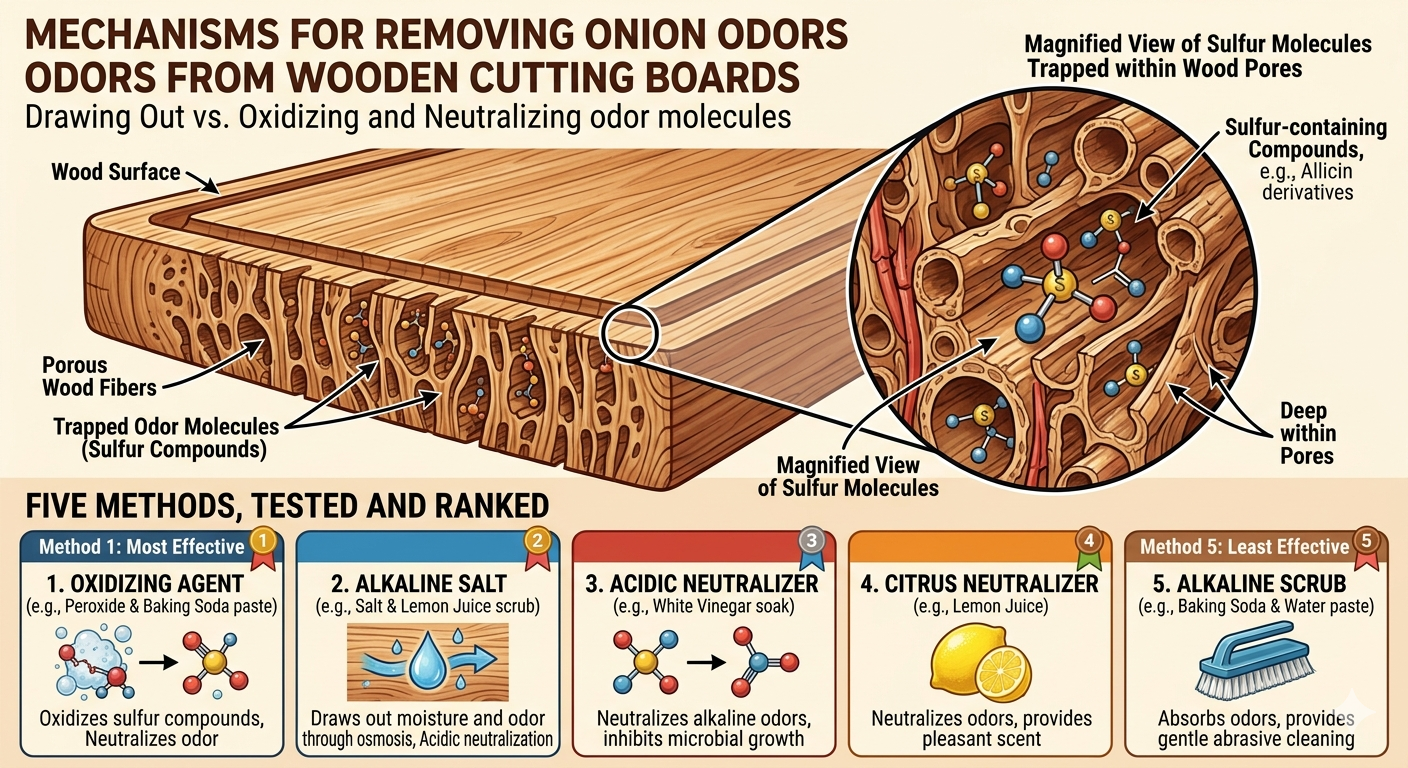
If your wooden cutting board smells like onion, you are not alone. Onion odor is the most stubborn smell to remove from wood because sulfur compounds from alliums penetrate deep into porous wood fibers—up to 2–3 millimeters below the surface. Soap and water only clean the top 0.1mm. This guide reveals five professional-grade methods to remove onion smell from cutting boards permanently, ranked from fastest to most powerful. We also explain why your board stinks and how to prevent it forever using proper oiling techniques.
Table of Contents
- Why Does Wood Hold Onion Smell So Stubbornly?
- Method 1: The Lemon + Salt Scrub (Fastest)
- Method 2: Baking Soda Paste (Best for Deep Odors)
- Method 3: White Vinegar Soak (Best for Bacteria + Smell)
- Method 4: Hydrogen Peroxide + Sunlight (Nuclear Option)
- Method 5: The Overnight Oil Soak (Prevention + Cure)
- Method Comparison: Which One Should You Use?
- What NOT to Do: 3 Mistakes That Make It Worse
- How to Prevent Onion Smell Forever
- Frequently Asked Questions
Why Your Wooden Cutting Board Smells Like Onion So Bad
Before you fight the enemy, understand it. Onions, garlic, and shallots contain organosulfur compounds—specifically allicin and thiosulfinates. When you chop an onion, these compounds release as volatile gases that literally soak into wood pores like ink into a sponge.
Wood is hygroscopic and porous. A typical maple cutting board has thousands of open pores per square inch. Once sulfur molecules enter these pores, standard dish soap cannot reach them. The smell persists because:
- Surface washing only reaches 0.1mm deep. Onion odor sits at 2–3mm.
- Dry wood acts like activated charcoal. It adsorbs odor molecules and holds them.
- Bacteria feed on trapped food particles. These colonies produce their own smells, compounding the onion odor. For a full sanitization guide, see our deep cleaning tutorial.
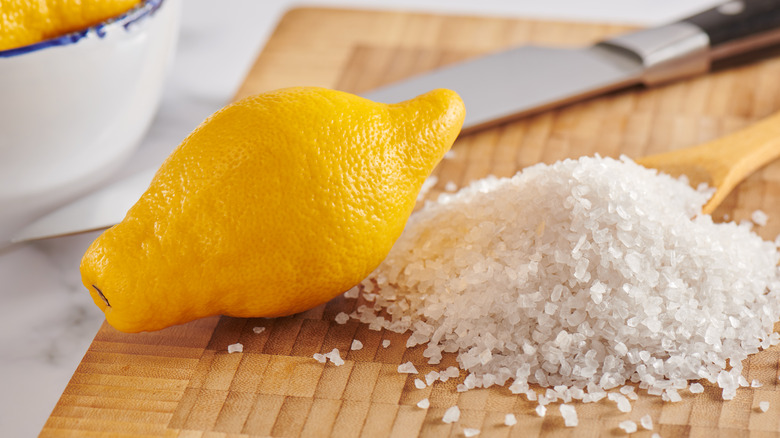
Method 1: The Lemon + Salt Scrub (Fastest – 5 Minutes)
This is the classic culinary school method. It works on 80% of mild to moderate onion smells and takes under five minutes of active work.
Why It Works
Salt is a natural abrasive that scrubs without scratching. More importantly, it draws moisture and dissolved odor molecules out of wood pores through osmosis. Lemon juice is 5% citric acid, which breaks down sulfur compounds on contact. The combination physically scrubs, chemically neutralizes, and deodorizes simultaneously.
What You Need
- ½ cup coarse kosher salt or sea salt
- 1 large fresh lemon, halved
- Bench scraper or spatula
- Clean towel
Step-by-Step
- Wash the board first. Remove all visible food debris with hot soapy water. Dry with a towel. The board must be damp-dry, not soaking.
- Spread salt generously. Cover the entire cutting surface with a ¼-inch layer of coarse salt. Pay extra attention to the area where you chopped the onion.
- Scrub with lemon. Use the cut side of the lemon as a scrubber. Grip it firmly and scrub in small circles with the grain for 2–3 minutes. Squeeze constantly to release fresh juice. The salt will turn gray as it lifts stains and odor.
- Let it dwell for 5–10 minutes. This is critical. The salt + acid combo pulls odor from 2–3mm deep. For heavy garlic/onion smell, wait the full 10 minutes.
- Scrape off the dirty salt. Use a bench scraper to push all residue into the trash. Do not rinse salt down the sink—it will clog drains over time.
- Rinse and dry. Quick 5-second rinse with hot water. Towel dry immediately, then stand the board upright for 2 hours to air dry completely.
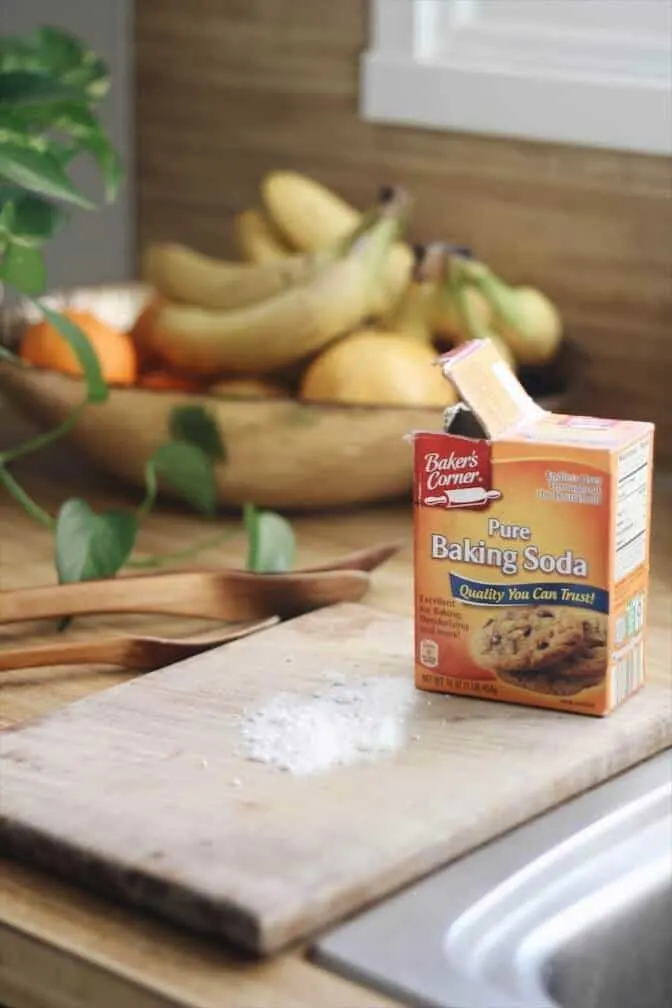
Method 2: Baking Soda Paste (Best for Deep, Set-In Odors)
If your wooden cutting board smells like onion and the salt method didn’t work, baking soda is the next step.
If the lemon + salt method left a lingering hint of onion, or if the smell has been building for weeks, baking soda is your next weapon. It is alkaline (pH 9), which neutralizes the acidic sulfur compounds from onions at the molecular level.
Why It Works
Baking soda (sodium bicarbonate) does three things: (1) Its mild alkalinity neutralizes acidic odor molecules, (2) Its crystalline structure provides gentle abrasion for scrubbing, and (3) It absorbs moisture that harbors bacteria. For extreme cases, adding lemon juice creates a fizzing reaction that penetrates deeper into wood pores.
What You Need
- 3 tablespoons baking soda
- 1 tablespoon warm water
- Optional: 1 teaspoon fresh lemon juice for extreme odors
- Soft sponge or cloth
Step-by-Step
- Make a thick paste. Mix baking soda and water until the consistency resembles toothpaste. It should be thick enough to stay where you spread it.
- Cover the smelly area. Spread the paste ¼-inch thick across the entire board surface, or concentrate on the onion-affected zones.
- Optional: Add lemon juice. For fish or extreme onion smells, drizzle lemon juice over the paste. It will fizz—this reaction drives the baking soda deeper into pores.
- Wait 30–60 minutes. Light odors need 30 minutes. Deep, weeks-old onion smell needs a full hour. The paste will harden and crack—this is normal.
- Scrub and rinse. Use a damp sponge to loosen the dried paste, scrubbing with the grain. Rinse with hot water until all white residue is gone.
- Dry thoroughly. Towel dry, then stand upright for 3–4 hours. Baking soda raises the wood grain slightly; light sanding with 220-grit after drying restores smoothness. For the full sanding process, see our restoration guide.
Method 3: White Vinegar Soak (Best for Bacteria + Smell)
Vinegar does not mask odors—it kills the bacteria that amplify them. A study by the University of California, Davis found that 5% white vinegar kills 99.9% of bacteria on wood surfaces after 10 minutes of contact time. This is essential if you cut raw meat and onion on the same board.
Why It Works
White vinegar (acetic acid, 5%) is a broad-spectrum antimicrobial. It kills odor-producing bacteria colonies living in knife grooves. While vinegar alone does not neutralize sulfur compounds as effectively as baking soda, it sanitizes the environment where smells thrive. Combined with Method 1 or 2, it is unbeatable.
What You Need
- Undiluted 5% white vinegar
- Spray bottle
- Clean cloth
- Timer
Step-by-Step
- Fill a spray bottle with vinegar. Do not dilute. You need full strength for the 10-minute kill time recommended by the USDA.
- Spray until visibly wet. Cover the entire board surface. The wood should darken as it absorbs the vinegar—this means penetration.
- Wait exactly 10 minutes. Set a timer. This is the EPA-required contact time to kill Salmonella, E. coli, and Listeria. Wiping early leaves survivors.
- Wipe and rinse. Use a clean damp cloth to remove vinegar, then do a quick 5-second hot water rinse. The vinegar smell dissipates as the board dries.
- Dry completely. Towel dry, then stand upright for 2–3 hours. Bacteria cannot multiply on dry wood.
Method 4: Hydrogen Peroxide + Sunlight (Nuclear Option)
For a wooden cutting board smells like onion for months, hydrogen peroxide is the nuclear option.
For a board that has been “onion-poisoned” for months and smells despite repeated cleaning, hydrogen peroxide is the nuclear option. It oxidizes and destroys odor molecules at the chemical level.
Why It Works
3% hydrogen peroxide (H₂O₂) releases oxygen radicals when it contacts organic material. These radicals break apart sulfur bonds in onion odor molecules. Sunlight accelerates this reaction through UV-induced photolysis. Together, they literally destroy the chemicals causing the smell.
What You Need
- 3% hydrogen peroxide (standard drugstore strength)
- Spray bottle
- Direct sunlight or UV lamp
- Timer
Step-by-Step
- Clean the board first. Wash with soap and water, then dry. Hydrogen peroxide works on contact with organic material—you want it hitting odor molecules, not loose food.
- Spray hydrogen peroxide generously. Cover the entire surface until wet. You will see bubbling—that is the oxygen radicals killing bacteria and breaking down odors.
- Place in direct sunlight for 1 hour. UV rays accelerate the oxidation reaction. If sunlight is unavailable, a UV-C sanitizing lamp at 6 inches distance for 30 minutes works.
- Let it sit 10 minutes total. After sun exposure, let the board rest another 10 minutes indoors.
- Wipe clean. No rinse needed. Hydrogen peroxide breaks down into water and oxygen—completely harmless.
- Oil the board immediately after. Hydrogen peroxide strips natural oils. Follow with a heavy coat of food-grade mineral oil to prevent drying and cracking. Not sure which oil to use? Read our best cutting board oil comparison.
Method 5: The Overnight Oil Soak (Prevention + Cure)
This is not a quick fix—it is a long-term solution. An unoiled board is like a sponge for odors. A properly oiled board repels them. If your board constantly smells like onion, it is probably chronically dry.
Why It Works
Food-grade mineral oil fills wood pores completely, leaving no room for odor molecules to enter. It also creates a hydrophobic barrier that prevents water and dissolved sulfur compounds from penetrating. Think of it as waterproofing for wood.
What You Need
- Food-grade mineral oil (USP grade)
- Clean lint-free cloth
- Wax paper or plastic wrap
Step-by-Step
- Clean and dry the board completely. Use whichever deodorizing method above worked best first. The board must be odor-free and bone-dry before oiling.
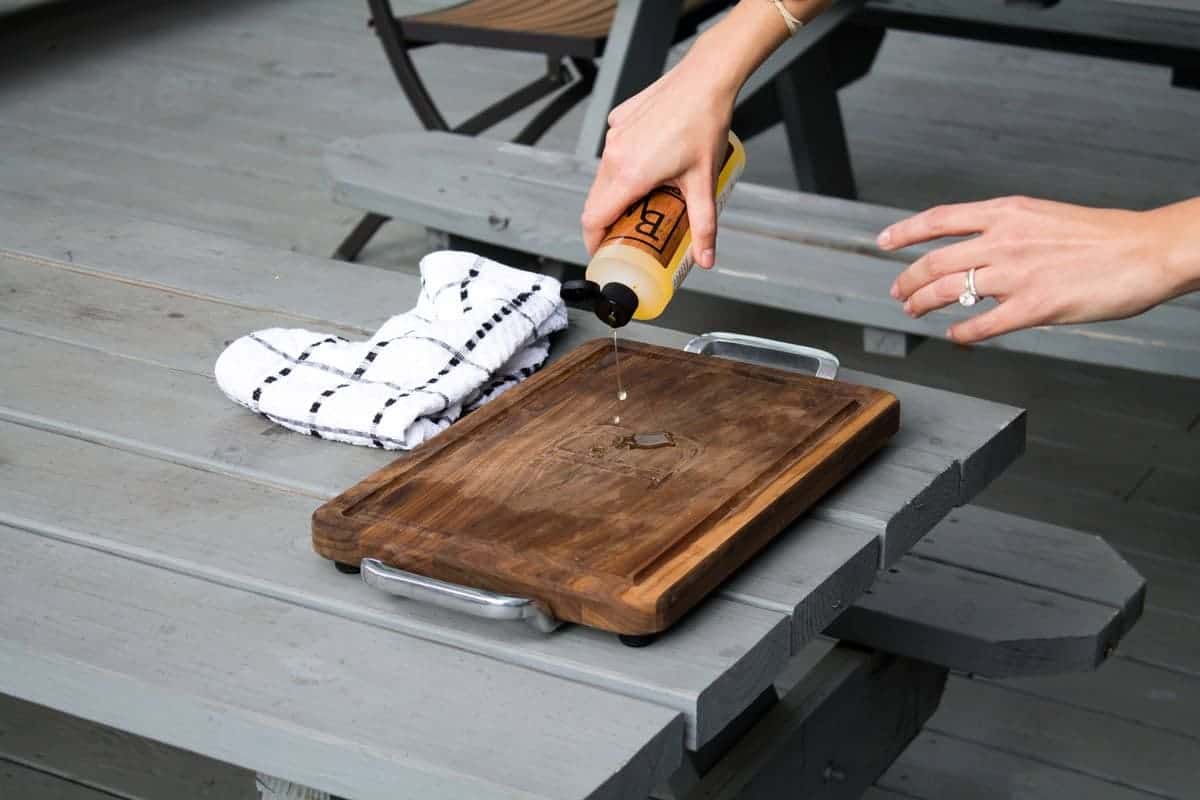
- Apply oil generously. Pour 3–4 tablespoons of mineral oil onto the board. Spread with a cloth, working against the grain first to open pores, then with the grain to distribute. Cover all six sides.
- Wrap in wax paper. This prevents dust from sticking and creates a humid microenvironment that helps oil penetration.
- Let it soak overnight (8–12 hours). Place the wrapped board on a baking sheet in case of drips.
- Wipe off excess. In the morning, use a clean dry cloth to remove every trace of surface oil. The board should feel satin-smooth, not greasy.
- Repeat monthly. A well-oiled board is odor-proof. Perform the water test monthly: if water stops beading, re-oil. Learn the exact schedule in our seasoning guide.
Method Comparison: Which One Should You Use?
| Method | Time Required | Odor Strength | Best For | Cost |
|---|---|---|---|---|
| Lemon + Salt | 10 min | Mild to Moderate | Fresh onion smell, daily use | $1 |
| Baking Soda Paste | 60 min | Moderate to Deep | Set-in odors, multi-week buildup | $0.50 |
| White Vinegar | 15 min | Any + Bacteria | Raw meat + onion cross-contamination | $0.30 |
| Hydrogen Peroxide + Sun | 90 min | Severe / Chronic | Months-old smell, failed other methods | $1 |
| Overnight Oil Soak | 12 hours (passive) | Prevention | Chronically dry boards, long-term protection | $3 |
What NOT to Do: 3 Mistakes That Make Onion Smell Worse
Avoid These Common Errors
- Don’t use cooking oil to “seal” the smell. Olive oil, coconut oil, and vegetable oil go rancid within 2-3 weeks. They trap odor instead of blocking it and create a sticky surface that harbors bacteria. Only use food-grade mineral oil or specialized board oils.
- Don’t put it in the dishwasher. The 160°F heat and water jets force onion odors 5mm deeper into wood fibers. It also warps boards and raises the grain permanently. Dishwashers void most cutting board warranties.
- Don’t use bleach. Bleach strips natural oils, dries wood fibers, and leaves toxic residues. The FDA does not recommend bleach for wooden food surfaces. It makes the board more porous, causing worse odor absorption later.
How to Prevent Onion Smell Forever
Treating odor is reactive. Preventing it is smarter. Follow these rules and you will never Google “wooden cutting board smells like onion” again:
1. Oil Your Board Monthly
A well-oiled board repels water and odor molecules. Perform the water test: sprinkle drops on the surface. If they bead up, you are protected. If they soak in, oil immediately. For end grain boards, you need more frequent oiling—learn the difference in our end grain vs edge grain guide.
2. Clean Immediately After Onion Use
Do not let onion residue sit. The sulfur compounds begin penetrating wood within 15 minutes of contact. Wash with hot soapy water immediately, dry thoroughly, and do a quick lemon + salt scrub once a week as maintenance.
3. Use Separate Boards for Alliums
Professional kitchens use color-coded boards for a reason. Designate one board exclusively for onions, garlic, and shallots. Your main board stays odor-free. A $20 secondary board saves your $100 primary board.
4. Never Soak Your Board
Soaking opens wood pores wider, allowing deeper odor penetration. It also causes warping. Rinse quickly under 10 seconds per side and dry immediately. For boards that are already warped, see our warped board fix tutorial.
5. Store Upright and Dry
Standing your board on its edge allows air circulation on both sides. Trapped moisture breeds bacteria that compound odors. Never stack boards flat against each other while damp. For complete care routines, read our Ultimate Guide to Cutting Boards.
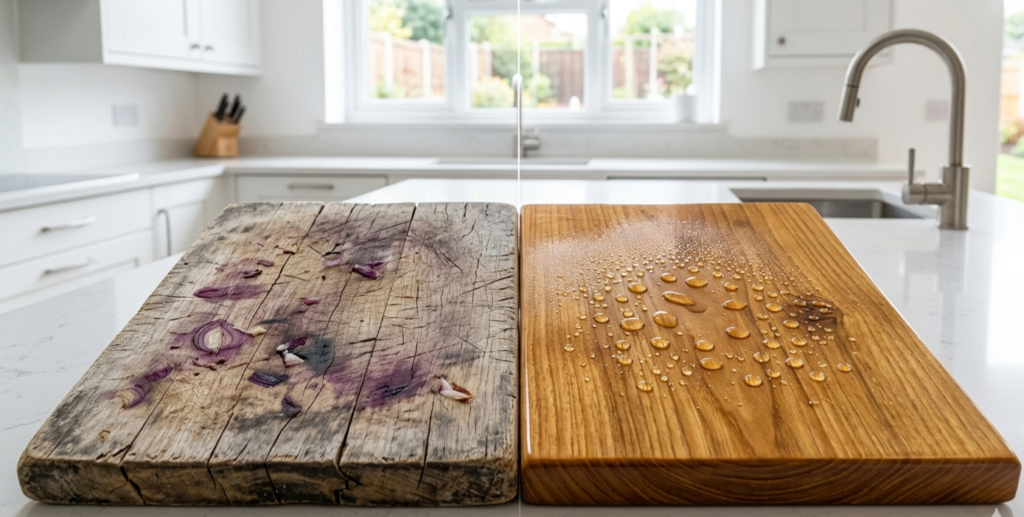
Many readers ask us why their wooden cutting board smells like onion even after washing with soap.
Frequently Asked Questions
Why does my cutting board still smell after washing?
Standard washing only cleans the surface 0.1mm deep. Onion sulfur compounds penetrate 2–3mm into wood pores. You need osmotic or chemical methods (salt, baking soda, or peroxide) to reach the depth where odor lives.
Can I use bleach to remove onion smell?
No. Bleach strips natural oils, dries wood fibers, and leaves toxic residues. The FDA does not recommend bleach for wooden food surfaces. It also makes the board more porous, causing worse odor absorption in the future. Use vinegar or peroxide instead.
How do I know if the smell is gone for good?
Smell the board 24 hours after treatment, when it is completely dry. Wet wood always smells slightly different. If neutral after drying, the treatment worked. If onion lingers, repeat Method 2 (Baking Soda) followed by Method 5 (Oil Soak).
Does onion smell mean my board has bacteria?
Not necessarily, but probably. Onion odor itself is just sulfur. However, the same cutting session usually involves raw meat or moisture that feeds bacteria. If the board smells sour (not just oniony), bacteria are definitely present. Disinfect with vinegar immediately. The NIH confirms wood can harbor bacteria if not properly maintained.
Can I sand the board to remove onion smell?
Yes, but it is overkill for odor alone. Sanding removes the top layer of wood where odor sits, but it also removes material and requires re-oiling. Try chemical methods first. Reserve sanding for boards that also have deep knife marks or stains.
Will the onion smell transfer to other foods?
Yes. An unoiled, smelly board will transfer odor and flavor to bread, fruit, and cheese cut on the same surface. This is why immediate deodorizing matters. Oil your board to create a barrier that prevents flavor cross-contamination. Choosing the right wood helps too—see walnut vs maple comparison for odor-resistant options.
Related Guides from WoodStuffHQ
- 🧽 How to Clean a Wooden Cutting Board: Deep Clean Guide 2026 — Master daily cleaning, disinfection, and stain removal.
- 🛢️ How to Oil a Wooden Cutting Board: Step-by-Step Guide — Learn which oils are safe, how much to use, and the 5-step method.
- ✨ How to Season a Wooden Cutting Board — Build a long-lasting protective barrier against odors and moisture.
- 📚 The Ultimate Guide to Cutting Boards: Types, Care, and Maintenance — Everything you need to know in one place.
- 📋 FDA Safe Food Handling Guidelines — Official recommendations for cleaning and sanitizing wooden food-contact surfaces without bleach.
- 🔬 NIH Study: Antibacterial Effects of Wood vs. Plastic — Peer-reviewed research on wood’s natural antimicrobial properties and proper maintenance.
- 🌡️ USDA Food Safety and Inspection Service — Best practices for preventing cross-contamination on cutting boards.
- 🔬 UC Davis Study: Vinegar Efficacy on Wood Surfaces — Scientific proof that 5% vinegar kills 99.9% of bacteria in 10 minutes.